

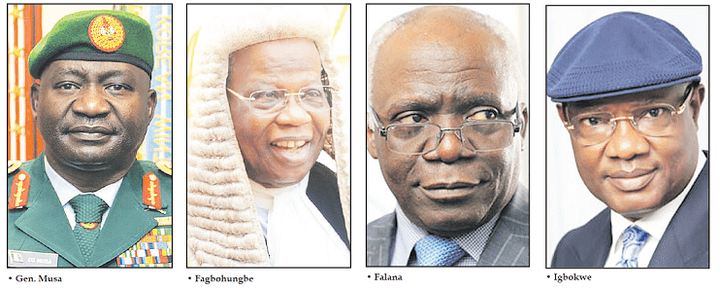
When reports surfaced last October that senior military officers had been arrested over an alleged plot to unseat President Bola Tinubu, the development stirred memories many Nigerians believed were consigned to history. For a nation shaped by decades of military rule, the mere whisper of a coup conjures images of midnight broadcasts and seizure of power.
With the military confirming that the suspects will face its tribunal in a democracy, a constitutional question looms: should alleged coup plotters be tried within the disciplined confines of a military court, or at the Federal High Court? Assistant News Editor PRECIOUS IGBONWELUNDU unties the knotty issue.
In October 2025, reports emerged that some officers, from the rank of Captain to Brigadier General, were arrested by the Defence Intelligence Agency (DIA) over an alleged plot to overthrow the administration of President Bola Tinubu.
At first, military authorities described the matter as an internal disciplinary issue.
Months later, the military confirmed that some officers and their civilian collaborators had indeed plotted a coup.
The Director of Defence Information (DDI), Major General Samaila Uba, stated that investigations had been concluded in line with military procedures and that the suspects would face a military tribunal.
Similarly, the Minister of Defence, General Christopher Musa (rtd), also said the accused would be tried by court martial and allowed legal representation.
The announcement triggered a legal debate: Can alleged coup plotters be tried by a court martial under Nigeria’s democratic order?
At the centre of the debate are two leading positions: One advanced by activist-lawyer, Mr Femi Falana (SAN), and the other by legal commentators who argue that the Armed Forces Act (AFA) permits military trials in certain circumstances.
Falana’s position
Falana vehemently opposed the trial by Court Martial, insisting that plotting to remove an elected President was not just a military infraction but a crime against the state that must be tried before a Federal High Court (FHC) under Section 41 of the Criminal Code Act which provides a life imprisonment punishment for any intention, manifested by an overt act, to depose the President during his term of office.
In his view, the constitution was unambiguous. Treason cases exclusively belong in the FHC, which he insisted cannot be replaced by a Court Martial in a democracy.
Falana submitted that the case file of the alleged coupist must be forwarded to the Attorney General of the Federation without delay, who should file a treasonable felony charge at the FHC pursuant to Section 251(2) of the 1999 Constitution.
“The military authorities who have threatened to try the alleged coup plotters in a military court should be advised to appreciate that the plot to sack a civilian regime is not a military affair.
“In any case, the decree for the trial of coup plotters being relied on by the military officers has been repealed while treasonable felony is not one of the offences listed in the Armed Forces Act,” stated Falana.
Falana further pointed out that some civilians were allegedly involved in the plot.
He said since civilians are not subject to service law under the Armed Forces Act, they cannot be tried by a court martial.
He relied on the decision of the African Commission in Media Rights Agenda v Nigeria (2000) AHRLR 5, where it was held that military tribunals should not have jurisdiction over civilians under any circumstances.
He also drew lessons from Nigeria’s military era. Under decrees such as the Treason and Other Offences (Special Military Tribunal) Decree No. 1 of 1986 and Decree No. 29 of 1993, alleged coup plotters, including civilians, were tried in camera by military tribunals. Those decrees were repealed before the return to civil rule in 1999.
The counter-argument
Opposing views focus on the structure of Section 251 of the Constitution.
While Section 251(2) gives the Federal High Court jurisdiction over treason, it does not use the words “to the exclusion of any other court.”
Those words appear in Section 251(1) in relation to certain civil matters.
Some legal analysts argued that this difference was deliberate, insisting that if the constitution intended treason cases to fall exclusively within the FHC, it would have used the same “exclusive jurisdiction” language found in Section 251(1).
They also referred to the Supreme Court’s interpretation of the word “shall” in BPS Construction & Engineering Co. Ltd v FCDA (2017), where the apex court held it might be mandatory or directory, depending on context.
READ ALSO: Residents flee to neighbouring states as bandits attack Bauchi community
This line of reasoning suggests that Section 251(2) confers jurisdiction on the FHC but may not necessarily exclude other competent courts, such as a court martial, from exercising jurisdiction over service personnel.
About Courts Martial
A court martial in Nigeria is a special military tribunal established under the Armed Forces Act (Cap A20, Laws of the Federation of Nigeria) to try personnel for breaches of military discipline, code of conduct, and certain criminal offences under service law.
A creation of both the Constitution and statute, the Court Martial derives its authority from Section 218(4)(b) of the Constitution, which empowers the National Assembly to legislate for the disciplinary control of the armed forces.
The Armed Forces Act (AFA) sets out offences, procedures, powers and appeal rights.
Courts martial are distinct from civilian courts because they deal with matters where military discipline, hierarchy and operational effectiveness are essential, such as mutiny, sabotage, desertion, insubordination, and other military-specific offences as provided by Sections 104 to 113 of the AFA.
Although the Act did not expressly mention treason or treasonable felony, Section 114(1) however, provides an omnibus clause covering “civil offences,” defined under Section 114(2) as any act punishable under Nigerian law. Subsections 114(3)(a) and (b) prescribe punishment for treason and other offences.
Section 129(a) (b) of the Armed Forces Act specifies two types of Courts Martial with defined roles, composition and powers- A General Court Martial (GCM) and a Special Court Martial (SCM).
While the GCM is the highest type and may be convened by military hierarchy like service chiefs, with a president, Judge Advocate and several members to try serious offences under the AFA, an SCM handles less grave matters with more limited sentencing powers.
For minor breaches, commanding officers may conduct summary trials without forming a full court martial, imposing administrative sanctions such as reprimands or fines.
Although rooted in military discipline, Nigerian courts martial are not arbitrary.
Accused personnel are entitled to legal defence (military or civilian counsel), the right to call and cross-examine witnesses, and the process incorporates many procedural safeguards similar to civilian criminal trials.
Decisions of courts martial are subject to civilian appellate review, primarily to the Court of Appeal and, on legal or constitutional questions, to the Supreme Court, thus integrating military justice within Nigeria’s broader legal framework.
The Supreme Court also recognised the status of the court martial as a judicial body in Olowu v Nigerian Navy (2011) LPELR-3127(SC), where the apex court described it as distinct from conventional courts but operating a criminal procedure akin to a jury trial.
A case for civilian courts
Senior Advocate of Nigeria, Wahab Shittu, aligned largely with the position earlier canvassed by Falana, arguing that the nature of the offence, not the status of the accused, should determine jurisdiction.
According to Shittu, treason and treasonable felony fall squarely within the exclusive jurisdiction of the Federal High Court under Section 251(2) of the 1999 Constitution, maintaining that a coup plot against a democratically elected government was an assault on the constitutional order, and therefore transcends military discipline.
He warned that allowing courts-martial to try such offences risks subordinating the Constitution to service law.
Citing Section 1(3) of the Constitution, he insisted that any inconsistency between the Constitution and the AFA must be resolved in favour of constitutional supremacy.
Shittu further argued that even the AFA recognises limits to military jurisdiction, pointing to Section 114(4), which excludes certain grave civil offences, including treason committed in Nigeria, from being tried as ordinary service offences.
In his view, this underscored the special constitutional status of treason.
Beyond statutory interpretation, Shittu raised concerns about democratic accountability, contending that offences threatening the existence of the state should be tried in open civilian courts to reinforce public confidence and civilian supremacy over the military.
Secretive or restricted military proceedings, he warned, could revive troubling memories of Nigeria’s military era.
Aligning with Falana, a female lawyer, Mrs Toyin Taiwo-Ojo, submitted that an attempted coup is a crime known to the Criminal Code as Treason, stressing that the accused is a serving military officer does not automatically confer court-martial jurisdiction.
“The nature of the offence indeed can override the status of the accused as military tribunals do not exercise constitutional judicial power and are not recognised by the law as having the constitutional power to prosecute offenders of treasonable felony.
“Only the superior court of records such as the Federal High Court, State High Courts, and the High Court of the FCT are constitutionally empowered High Courts for trying serious criminal offences such as treason and attempted coups.
“Treasonable felony is an offence against the state and therefore has gone beyond the mere disobedience of military laws.
“Mr Falana is right to insist that persons so accused, even if they are military officers, should be tried in civilian courts, especially in a civilian government where the constitution reigns supreme.
“There are precedents in the Nigerian courts where it was held by the courts that trying such cases in any other court was unconstitutional. See the case Mandara v. Attorney-General of the Federation (1984).”
Friday Mameh argued that a court martial lacked the jurisdiction to try the arrested officers, insisting it was easy, purely a matter for the Federal High Court, because the alleged crime was committed against a democratically elected government.
Why Court Martial is valid
In an interview with The Nation, Gen. Musa restated why the suspects would face a GCM, reminding Nigerians that the coup plot was against the Commander-in-Chief of the Armed Forces, the highest military rank in the country.
The minister argued that the alleged coupists are military men who wanted to conduct a military operation, wondering where those against the Court Martial came about the quoted ambiguity.
“They’re military men. They wanted to conduct a military operation against the Commander-in-Chief (a military rank), so they should go to a military court. It’s that simple. I don’t know what the lawyers are talking about.
“Even those who took arms in Afghanistan, the U.S. instituted a court-martial for them. They used military law, and those were not even their citizens.
“Anytime you take up arms or commit an offence that is military-bound, you should face military law. It’s pure and simple. No sentiments about it,” said Gen. Musa (rtd).
Supporting a military tribunal, constitutional lawyer, Chief Felix Fagbohungbe (SAN) said there was no legal conflict, citing national security considerations and the constitutionality of such specialised courts for security-related matters.
Fagbohungbe said: “I cannot say they should be tried in a conventional court. Falana can express his view, but what is often left unsaid is what is most important.
“They are court-martialed because of the national security involvement. The Constitution gives them the jurisdiction to deal with these matters in a military manner. It is a matter of the Constitution’s definition.
“There is no conflict between the constitution and military law. The constitution creates all the courts and gives the National Assembly the power to make laws for specific purposes.
“The source of law is the Constitution and that of Parliament. I am certain that the court-martial is exclusively for the military due to security. I do not agree that they must be arraigned in a conventional court.
“The court made it clear that once a soldier is arrested, the commanding officer must be notified and the accused must be given the opportunity to elect.
“These matters are not new, the law reports are replete with cases where courts martial were properly conducted, appealed against, and in some instances overturned.”
Fagbohungbe stated unequivocally that military courts are the proper forum for alleged coup plotters. He compared military tribunals to other specialised courts and disciplinary bodies by institutions.
“They can deal with offences related to security matters. If a party disagrees with a decision, they can appeal to the Court of Appeal.
“Lawyers also have disciplinary committees. If you commit an offence or violate their rules, you may be dismissed.
“If you disagree, you can go to the Court of Appeal or the Supreme Court. The military system works in the same way. It is a specialised situation.
“It is permitted under the Constitution and does not violate any provision of it.”
A reformative military lawyer, Maj. Gen. Mahmood Wambai (rtd), in his submission, held that the Court Martial was the appropriate tribunal for the suspects because they were serving officers.
“Any serving officer is subject to service law, which is the Armed Forces Act. The Act covers offences committed under civil and military laws. Therefore, those accused of attempting a coup should be tried by Court Martial, since they are serving personnel,” he said.
Renowned lawyer, Norrison Quakers (SAN), said the accused officers remain primarily subject to military justice. While acknowledging that soldiers are governed by both civil and service law, he emphasised that specific procedural safeguards under the Armed Forces Act must first be complied with before any civilian prosecution.
Quakers explained that once a soldier is arrested, the matter must be reported to the commanding officer, who must inform the accused of the allegation and require them to elect whether they wish to be tried by court-martial or in a civilian court.
He described this right of election as a mandatory condition precedent, warning that failure to comply renders any prosecution a nullity.
“It is similar to the Miranda rights in the United States. If a suspect is arrested and you fail to inform him of his rights before extracting a statement, that statement becomes worthless in law. The same principle applies here.”
Quakers relied extensively on the Armed Forces Act, reading from Section 114.
“Section 114 of the Armed Forces Act provides that ‘a person subject to service law under this Act who commits any other civil offence, whether or not listed under this Act or committed in Nigeria or elsewhere, is guilty of an offence under this Act.’”
“Section 114(3) goes further to state that ‘a person convicted by a court martial of an offence under this section is liable if the corresponding civil offence is treason or murder or death.’ That provision is explicit. It uses the word treason.
“If you read Sections 121 and 123 together with Section 114, particularly subsection (3), it is very clear that this category of offence falls within the jurisdiction of a court martial, except where the accused elects otherwise.”
Quakers said Nigerian courts have repeatedly affirmed this procedural framework.
“A case that readily comes to mind is Chokwe Stone v Chief of Naval Staff. The court made it clear that once a soldier is arrested, the commanding officer must be notified and the accused must be given the opportunity to elect.”
He also referred to Showperson v Nigerian Navy.
“These matters are not new. The law reports are replete with cases where courts martial were properly conducted, appealed against, and in some instances overturned.”
The senior lawyer maintained that coup plotting is synonymous with treason and recognised both under civilian criminal law and service law. Relying on Section 114 of the Armed Forces Act, particularly subsection (3), he argued that the Act expressly contemplates court-martial jurisdiction over treason, subject to the accused’s right of election.
Quakers also stressed that courts-martial are constitutionally recognised tribunals whose decisions are subject to appeal up to the Court of Appeal and the Supreme Court. He noted that civilians cannot be subjected to court-martial, insisting that uniformed personnel remain within the military justice system unless they validly opt otherwise.
Quakers dismissed the idea that the law was ambiguous and needed reforms, insisting that alleged coup plotting by soldiers remains primarily a military matter.
Also, a former Admiral Superintendent, Naval Ordnance Depot (ASNOD), Rear Admiral Livingstone Izu (rtd), said the law was clearly in support of a Court Martial for service personnel, adding that all serving military officers were bound by the rules.
“This is not a complicated matter. They are service personnel and subject to military law first. That is why in some cases, you see the military after trying its personnel will still hand them over to civilian authorities for prosecution.
“The Court Martial allows the suspects to have legal representation of their choice and they can appeal its decision to the Court of Appeal,” he said.
Similarly, Michael Igbokwe (SAN) agreed that the Court Martial has the jurisdiction to try the suspects, noting that such tribunals have historically been used to discipline and try military personnel for service-related offences.
Igbokwe dismissed arguments that a court martial would be unconstitutional to try the alleged coupists, stressing that the military justice system is specifically designed to regulate the conduct of serving officers and soldiers.
“The answer is simple. Courts-martial have always been used for trying and disciplining serving military men and women. That is what regulates them. That has always been the practice, and I am not sure it has changed,” he said.
According to him, it was settled law that decisions of courts-martial are subject to judicial review.
“It has since been decided that even after a court-martial, there is a right of appeal to regular courts which can review the decision. But the trial itself is always by court-martial or military tribunal, settled within the military hierarchy, because these are military offences concerning military personnel.
“You cannot try them in a regular court. What exactly would you be trying them for, especially when they are military men?” he asked.
Another lawyer, Abiodun Kolawole, said the Court Martial was appropriate for their trial under the country’s military justice framework, explaining it was a legally established mandatory first step for military personnel.
“Because of the current democratic government, once they say the matter should go by way of the Armed Forces Act, you cannot try a person in a regular court while he is still a serving personnel.
“They cannot prosecute him like an ordinary citizen. That is why there is a special court,” said Kolawole, who traced the legal framework governing court-martial to the consolidation of military laws in 1993.
Kolawole explained that if a court-martial finds an officer guilty, dismissal from service must come first before any further action.
“Once they try you and find you guilty, the first thing is dismissal. After that dismissal, they do not just hand you over to the police immediately,” she said.
An Ibadan-based forensic advocate, Asiwaju Kunle Kalejaye (SAN), believes soldiers accused of plotting a coup should be tried in a Federal High Court, not a military court-martial.
He said: “This is because treason and treasonable felony are constitutional crimes that fall under the jurisdiction of civilian courts.
The Constitution, specifically Section 251(2), grants the Federal High Court jurisdiction over treason, treasonable felony, and allied offences.
“Trying them in a military court-martial would be inconsistent with democratic principles and undermine the supremacy of the Constitution.
Being the grundnorm, no law is allowed to conflict with it.
“However, it’s worth noting that military personnel can be tried under military law via court-martial for breaches of military discipline, but coup plotting is considered a grave crime against the state, warranting trial in a civilian court.
“It is instructive to note that the President and government against which the plot was addressed were all democratically elected.
“The Armed Forces Act, it is noted, omitted the offence of treason in its provisions.
“I am not prepared to argue that its Section 114 omnibus provision would allow it to assume jurisdiction over treasonable offences.
“If indeed we are running a democracy, then the Court Martial, with its secrecy and regimented approach to justice, has no place in a democracy. After all, the Constitution is Supreme!”
The way forward
To resolve the conflicts, Shittu called for a structured framework that allows military tribunals to. handle purely service-related offences such as mutiny and desertion, while treason and treasonable felony against a civilian government should be tried in civil courts. He advocated stronger appellate oversight and legislative reforms to clarify the “nature-of-the-offence” test.
Shittu concluded that only a definitive pronouncement by the Supreme Court or legislative amendment can finally settle the jurisdictional conflict, but insisted that, as it stands, the Constitution favours civilian trials for treason.
“The current legislative efforts to reform the Armed Forces Act provide a timely opportunity to bridge the gap between military necessity and constitutionalism. Ultimately, a justice system that subjects even the gravest military crimes to the oversight of the civilian judiciary is the strongest safeguard against both military adventurism and judicial overreach,” he said.
To Quakers, the problem in Nigeria is not lack of laws but attitudinal, stressing that the rules, laws and regulations have existed for years without strict compliance.

Join Our WhatsApp Channel
To join: Simply click on the link below and turn on notifications to receive the latest scholarship, job, and opportunity updates instantly.
Join WhatsApp Channel